
CEOs, where is your leadership team bleeding impact?
You may be bleeding impact when your GM is spending more time helping the team get through the day than on the work that moves the business forward.
Or when your HR team is spending more time reprimanding and dealing with issues than coaching, developing and strengthening your leaders.
Or when your Operations leader is repeatedly firefighting the same problems instead of improving the systems and processes that could stop them happening in the first place.
Often, this is because it’s what your leaders keep going back to. It’s their default.
They step in. They solve. They fix.
Some take over. Others retreat into humour or small talk when a performance conversation feels uncomfortable - making the moment easier, but missing the opportunity to give the feedback that could actually help that person grow.
We all have defaults. Until we’re aware of them, we keep going back to them - sometimes even when the situation needs something different. And that’s where bottlenecks can start.
Hi, I’m Sharm. At Lead Smarter, we teach Cognitive Range that helps leaders go beyond their default and draw on more options when the situation calls for it. Our work helps organisations see where their leaders may be bleeding impact, identify the defaults behind it, and build the range to respond differently when the situation calls for it.
Start by taking the 15-question Leadership Impact Scorecard and find out where your leadership team may be bleeding impact.
"If you could give your leaders one hour back, where would you want them to spend it?"
This is the question I ask the CEOs and HR Heads of the teams I coach.
The answers are usually about the things that actually move the business forward - building self-reliant teams that don’t need constant supervision, finding where money or time is leaking, fixing problems properly instead of repeatedly firefighting them, developing the next layer of leaders, improving decisions, strengthening customer relationships, and creating room to think about growth.
Because logically, if your leadership team is not owning this space, then who is?
When I ask leaders the same question, delegation, coaching, developing others and stepping back from the day-to-day stop being just leadership skills they're expect to learn.
They start to see these differently - as ways to create more capacity for higher-impact work, while at the same time helping their teams become more capable and less dependent on them.
And that’s really the shift.
How do we help leaders step away from what’s taking up so much of their time now, and start using that time where they could 10x their impact on the business?

What starts changing when leaders build Cognitive Range?
When leaders have more than one way to respond, the change isn’t just in the leader. You start seeing it in how the team operates, where decisions get made and what leaders finally have the capacity to focus on.
FROM DEPENDENCY TO OWNERSHIP
Leaders stop needing to be the answer to every problem.
They coach more, delegate more and give people the space to work things through themselves. The team becomes more capable. Decisions don’t always need to travel upwards. And the leader gets back some of the capacity that was being absorbed by work others can learn to own.
FROM DEFAULT TO CHOICE
Leaders stop relying on the same response every time.
They start noticing when their usual way of leading isn’t what the situation needs. Sometimes they need to step in. Sometimes step back. Challenge. Listen. Slow down. Decide faster. Coach instead of solve. The difference is that they now have a choice.
FROM FIREFIGHTING TO FUTURE-FOCUSED
Leaders create more room for the work that moves the business forward.
Instead of repeatedly getting pulled back into the same problems, they start looking further ahead to improve processes, develop people to take on more, find where time or money is leaking, strengthen key relationships and move important work forward. They spend less time reacting to what’s happening now, and more time shaping what happens next.

How we do it: Beyond the Default
I’ve had many clients come to me asking for training on time management, delegation, difficult conversations, coaching and other leadership skills. And these are important. There are also plenty of good skills-based programs out there that can help.
My 20 years of working with leaders have taught me that every leadership team is different. They face different challenges, create different bottlenecks and have different development needs from one company to the next.
So before I build a solution, I want to understand where your leadership team is actually bleeding impact, and why.
- Is it because leaders are holding onto too much?
- Avoiding conversations?
- Stepping in too quickly?
- Solving problems their teams could learn to solve?
- Staying too close to the detail?
- Accidentally triggering their peers?
Once we can see where the bottleneck is, we look at the default behind it.
- What does this leader naturally go back to?
- How is this intensified when under pressure?
- What has worked for them before?
- And where is that same response now limiting the impact they could be having?
From there, we introduce the development that actually makes sense for that leader and that business.
This is what Beyond the Default means to us.
We use tools like the Colored Brain Communication Inventory™ to help leaders understand what comes naturally to them, then work with real situations they are dealing with at work to practise other ways of responding.
I wouldn't want a leader to leave one of our sessions simply knowing more about leadership. I want them to have more options the next time they’re in a situation where their usual response isn’t going to get them the outcome they need.
Our work helps them become less limited by what comes naturally to them.
Why do capable leaders keep falling back on the same response?
Because what’s familiar is easier to access.
We all have ways of thinking, processing information and responding that come more naturally to us. And when there’s pressure, uncertainty or not much time to think, those familiar responses can become even easier to fall back on.
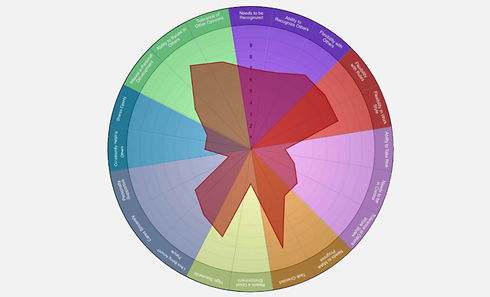
At Lead Smarter, we use the Colored Brain Communication Inventory™ to help leaders understand how they naturally process information - how they gain clarity, make sense of what’s happening, make decisions and move towards action. Once they can see that, a lot of everyday leadership behaviour starts making more sense.
- A leader may rush in and solve because waiting feels inefficient.
- They may hold onto control because delegating feels risky.
- They may keep giving direction, then wonder why their team isn’t becoming more independent.
- Or they may say something with perfectly good intent, without realising how differently it lands for someone who processes things another way.
The point isn’t to put leaders into a colour or a box. It’s to show them their starting point.
Because once a leader can recognise:
“This is what I naturally do.”
...they can start asking:
“Is this what this situation actually needs from me?”
Then we work with the real situations they are dealing with to help them practise responses that may not come as naturally - so they have more options available when they need them.
What happens when leaders start leading beyond their default?
Here are some of my most recent client testimonials
Mark Hitchins
National Resource Manager
"Since I started the training, I started delegating more, giving team members scope to take charge of their workspace and being more aware of my duty to guide. "
Steve Ryan
National Operations Manager
"The Coloured Brain and Predictive Index profiles were very accurate and useful tools in understanding our own, and others' communication and leadership styles."
Tim McDonnell
Business Development Manager
"The program has enabled me to recognize traits in my own personality that I was not aware of, and helped me communicate more effectively with my colleagues"
A little about how I work

I work closely with every leader
I am proud of every leadership team I’ve worked with, and to see them grow beyond their default.
Because of the 90–60–15 Learn–Apply–Embed model I use, I have one-to-one time with every leader to unpack the module and how they’ve applied it.
One leader’s feedback highlights the impact of this really well:
“I have enjoyed the way Sharm has presented the leadership program and the one-to-one sessions have helped to personalize the content and get more out of it than I might have otherwise.”
Sometimes the conversations get intense. That’s okay.
A Managing Director client of mine once joked that being in a session with me feels therapeutic - and I admit, it’s true!
What feels like therapy is probably my ability to speak directly to the leaders’ experiences, always relating back to why they defaulted to their natural response, or why they feel frustrated.
I like to dive deeper into those frustrations, because a frustrated brain wants to react. It wants to go back to what feels familiar - and often, that’s not beneficial to the leader, their team members or their peers.
I value and encourage honesty in my sessions, so some sessions can get intense. It’s about giving leaders a controlled space to share their thoughts openly with their peers in the cohort, because these discussions are simply gold.
There’s very little that can upskill a leader in their own environment quite like the luxury of learning with their colleagues - learning from them and learning about them.
Here's what a leader shared about their experience with the program
“Sharm has engaged the team well and helped us to share comments, learnings, and experiences around the leadership and personal interactivity we have come together to improve our team dynamics and performance.”
My work is very insights-based
When I discuss my report with the CEO or HR Head, there’s a lot of linking the whys back to the Colored Brain results, my observations of how the leaders have progressed from module to module, and their 360 results and feedback on progress.
So every piece of feedback and every recommendation I make has something behind it.
One leader said
“She knew her topic very well, easily related that back to our working environment, was always prompt and her feedback relevant.”
And I like what another leader said after the program:
“The program has enabled me to recognize and understand traits in my own personality that I was not aware of. It has helped me to understand and communicate with my colleagues more effectively.”
The part I’m most proud of
I’ve worked with CEOs and leadership teams across industries and countries, including manufacturing, retail, hospitality, education, IT, and the list keeps growing.
My proudest moments are when I hear the language of the program being woven into how leaders see their teams, how they see things differently, and what they’re starting to consider when they think about widening their impact.
I am humbled by the growth of all the leaders I’ve had the pleasure and honour to coach and equip. They are truly geniuses and legends in their own fields - as talent, as leaders and as people.
I appreciated what this HR Head said about our opportunity to work together:
“Sharm is a true Organisational Development Leader. I have had the pleasure of working with Sharm across various organisations now, and her approach to leadership and organisational development has always been in genuine collaboration with the business and its Executive team. Her approach to all things development is not only tailored to the industry and cohorts she has managed, but delivers 100% on the target areas with tangible positive outcomes. Sharm is not afraid to push people out of their comfort zones to help them achieve best outcomes individually, and as a team. I really valued this about the relationship we continue to build on.”
Get in touch
If something on this page has made you think about your own leadership team, let’s talk about it.
Tell me what you’re seeing, where your leaders may be getting stuck, and what you’d like to see happening differently.
I’m not going to assume you need a leadership program. We’ll simply look at what’s happening and whether there’s something useful I can help you with.
You can email me directly at sharm@leadsmarter.org.
I'm also on LinkedIn : linkedin/sharmsiva

